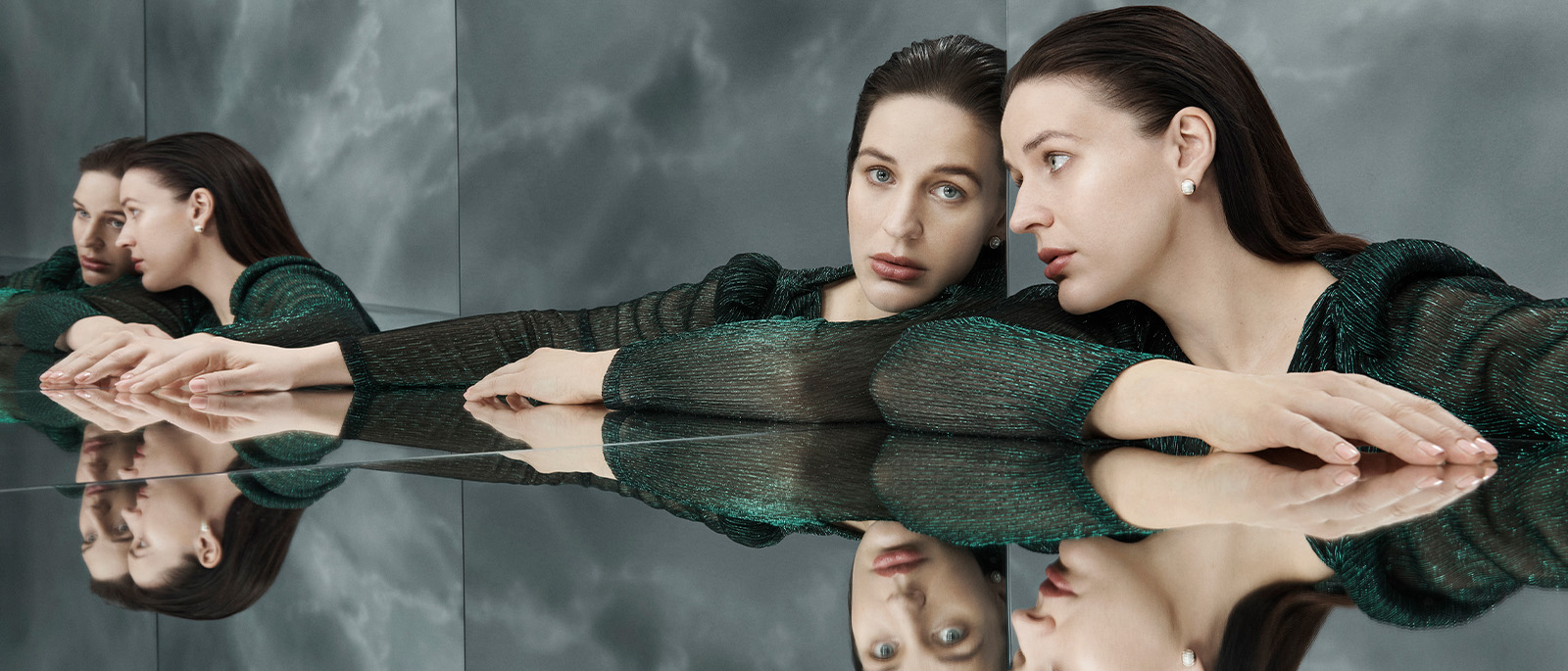
The opening of the second half of the 2025–26 season on March 9 is sure to be a Wagner event for the ages, as blazing soprano Lise Davidsen headlines the composer’s all-consuming epic Tristan und Isolde after years of anticipation. With heroic tenor Michael Spyres as Tristan and Music Director Yannick Nézet-Séguin on the podium, the stage is set for the premiere of a daring new production by director Yuval Sharon, who sees the opera as one transcendent episode in an endless cycle of death and rebirth.
Lilli Lehmann. Kirsten Flagstad. Astrid Varnay. Birgit Nilsson. The names of the superhuman sopranos who owned the role of Isolde in earlier eras at the Met have become synonymous with soaring high notes, thunderous power, and endless reserves of volcanic sound. This season, the company is poised to add another name to this list of legends.
Since making her Met debut in 2019, Norwegian soprano Lise Davidsen has showcased a golden-age Wagnerian voice, giving unforgettable portrayals of Chrysothemis in Elektra, Leonora in La Forza del Destino, Eva in Die Meistersinger von Nürnberg, and the title characters of Ariadne auf Naxos, Tosca, and Fidelio, among others. Now, she strikes at the heart of the dramatic-soprano repertoire as the proud Irish princess Isolde, a role she seems born to sing. Powerhouse tenor Michael Spyres makes a major role debut as Tristan, completing the couple whose enmity transforms to insatiable and self-annihilating passion thanks to a potent love potion. Met Music Director Yannick Nézet-Séguin takes the podium to conduct one of the most important scores in all of music and lead the remarkable cast, which also features mezzo-soprano Ekaterina Gubanova as Brangäne, bass-baritone Tomasz Konieczny as Kurwenal, and bass-baritone Ryan Speedo Green as King Marke.
The Met’s new Tristan und Isolde also marks the company debut of one of today’s most innovative and in-demand theatrical minds. Hailed as “the most visionary opera director of his generation” by The New York Times, Yuval Sharon arrives at the Met having made a name for himself with his inventive approach to stagecraft, which has resulted in a one-hour adaptation of Wagner’s Götterdämmerung in a parking garage, a site-specific world premiere amid the bustle of Los Angeles’s Union Station, and Puccini’s ever-popular La Bohème presented in reverse. His productions have won raves across Europe—including at the famed Wagner festival in Bayreuth, where he was the first American ever to direct a production—and as artistic director of Detroit Opera, he has overseen the company’s transformation into a leader on the American operatic scene.
Preparing to direct Wagner’s towering masterpiece, Sharon—who will also helm the company’s new Ring cycle in future seasons—discussed his deep affinity for the composer’s work, the timelessness of Tristan und Isolde, and navigating the space between this world and the next.
You’ve been called “opera’s disrupter in residence.” Do you feel that’s a fair representation?
It’s a fun title, but I don’t necessarily approach a project thinking I need to break something for the sake of making something different. I believe in opera’s power to connect with an audience, but I also think the best operas ask their audiences to be courageous and experience something they never have before. Tristan und Isolde still sounds so modern today, I can’t even begin to imagine how audiences in 1865 made sense of the world premiere. And I feel my responsibility as the director is to find new ways of making Wagner’s original audacity visible to a contemporary audience. That means constantly questioning how the opera lives on stage—in the interaction between performers and in the visible dimensions of the production’s design world—and that often leads me and my team into wondrous and unexpected discoveries. I think that sense of awe was precisely what motivated Wagner as well.
How would you describe your relationship with Wagner’s work?
The second opera I ever saw was Siegfried, and that might seem like a hard sell to a 13 year old who was much more into Star Wars than anything resembling opera. But even as a kid, something about Wagner’s vision of a total work of art found a way to stir my curiosity as an audience member with almost no experience of the art form. I never imagined then that I would dedicate so much of my life to realizing his works on stages around the world, including at his own theater, Bayreuth, and soon on the incredible stage of the Metropolitan Opera. Although different aspects of Wagner’s operas fascinate me now that I’m in my 40s, I find it astonishing that the same work can simultaneously speak to people of different generations and across different centuries. As I prepare productions of Wagner operas now, I keep in mind the 13 year olds in the audience that may be having their very first encounter with opera. They deserve access to that overabundance of imagination that makes Wagner so compelling to those of us who fell in love with his works.
Tristan und Isolde is a work that has been endlessly analyzed and discussed since its premiere 160 years ago—and one that can be interpreted in countless ways. What particular aspects of the opera do you hope to explore in this production?
Tristan und Isolde is often called, rather gloomily, “a song of love and death,” but I think this has misled audiences for generations.This opera is less interested in the finality of death than the ecstatic mystery of rebirth. The entire piece is a ritual encounter that leads toward Act III, in which Wagner shows us two ways to face death: We see Tristan dying slowly and in agony, terrified, disoriented, clinging to his ego and suspecting that his life has been a meaningless string of suffering. And then we have Isolde, who dies rapturously, willingly, and completely letting go. Her final aria has become known as the “Liebestod,” or “love-death,” but Wagner instead described her final moment as a transfiguration, which I think is so much more appropriate. Replacing the linear notion of death with the cyclical idea of rebirth is at the heart of our production.
Can you elaborate?
The poetry of Tristan revolves around images of polarity: day and night, male and female, life and death. Those images are at the core of both the text and the music. Right from the very first measures of the prelude, Wagner famously overlaps two separate musical ideas on top of each other. The result is an unresolved chord, the “Tristan chord,” that holds in miniature the tragedy of the entire opera: two forces that are close together but won’t unite, as desperately as they try. In that gap, in that search for resolution, is the longing for union—in the libretto you will hear the word “Sehnen,” which Tristan and Isolde feel as a romantic, erotic, and mystical drive towards each other. If union is the true nature of reality, then that polarity is a delusion they are desperate to overcome. I was looking for a way to visualize these tragic oppositions on stage, as well as the notion that there is another reality underneath the world of binary logic.
How will you represent this on stage?
To explore polarity, we are introducing a “split world” into our production: Let’s call it the “world of the table” and the “world of the fable.” At the start of the opera, the singers will appear on the stage in a way that will feel very recognizable to us in 2026, closer to a contemporary couple. At the table, arranged ritualistically, are all the objects that have the totemic power to bring us into the world of Tristan and Isolde’s story. As the music unfolds, those objects become portals into another dimension, containing the landscapes of the opera: The water in the jug becomes the ocean centuries earlier, as Tristan’s ship carries Isolde to King Marke. The couple at the table become possessed with the music and the story, occupying both worlds at once: our world, from the standpoint of 2026, and the mythic world of the opera, existing in the blurred historical moment of legend. Like shamans, they will stand in the visionary space containing two realms. And this, I think, is the herculean task given to the singers of this opera as they take on the enormous roles that Wagner wrote for them. They bravely become vessels for the enormous emotional and psychological experience of the audience, even as they remain two fragile individuals, Lise Davidsen and Michael Spyres. The first tenor who performed Tristan died shortly after the first performances, and everyone blamed Wagner for writing such a strenuous role. I want the audience to understand how dangerous this work really is, and to realize how grateful we are that Lise and Michael are brave enough to take us to the depths and the heights that this score demands of them.
Your set designer, Es Devlin, has received acclaim for her work across opera, theater, concerts, and art installations. Tell me a little about her scenery for the production.
To visually frame the opera as a kind of ritual of death and rebirth, Es has created a tunnel that represents potential death—like when people who have near-death experiences talk about going toward a light at the end of a tunnel. But it could also be a tunnel to a new birth. In Act II, Tristan’s mysterious answer to King Marke’s devastating monologue is to imagine death as a return to the womb. We don’t fully reach the tunnel until Act III, as Tristan lingers between life and death, but in the previous acts, we use elements from the tunnel in bits and pieces to create the settings for the other scenes. The entire set will also act as a giant canvas for projections.
So it’s safe to say that video also plays a major role in the production?
Yes. Ruth Hogben is an incredible filmmaker who can take everyday objects and make you look at them in ways that you’ve never considered before. Together with my frequent collaborator Jason Thompson, we are going to use video to magnify the ritualistic objects and create the illusion that they contain a whole universe. For example, in the climactic scene of Act I, Isolde confronts Tristan about the moment she had his life in her hands: She held his sword up to his neck, and through an unexpected swell of emotion, she dropped the sword and let him live. In our production, the Isolde sitting at the table will pick up a knife and hold it to the neck of the more contemporary Tristan sitting across from her. We see a glinting knife projected onto the stage, and then the set opens up, containing the mythic Tristan and Isolde within that knife. The entirety of their history lives in the gleam of that knife. Then, at the start of the second act, Isolde will light a candle at the table. Through video and projections, it will seem as if Brangäne’s voice is coming from inside the light of the candle: the nagging, persistent voice of caution that Isolde snuffs out before she abandons herself to her lover, even as she knows it will bring about their own destruction.
What do you hope audiences take away from this production?
A fundamental aspect of how I think about opera is that there are as many potential takeaways as there are audience members. I want to offer an interconnected web of narrative ideas, visual ideas, and conceptual ideas as a kind of forest for the audience to wander through and make the piece their own. Tristan und Isolde is probably the single hardest opera in the entire repertoire. It’s hard for the singers, who have to sing these enormous roles. It’s hard for the conductor and the orchestra, who go through such an endurance test playing this extraordinary score. And it’s hard for me as a director, as I try to find a theatrical language to convey everything Wagner is saying in this complex musical and dramatic text. The only people it’s not hard for are the audience. They get to go on a transformational ride into the unknown realms of ocean, cosmos, and self. So I hope they will let the vortex pull them in, and that they will wander through this forest with us.
Interview by **Matt Dobkin
**Edited by Christopher Browner